Mattress sizes
Full (Double) Mattress Dimensions
Quick answer
A Full (Double) mattress measures 54 inches wide by 75 inches long (137 by 191 cm), which is 28.1 square feet of sleeping surface. Shared by two people that is 27 inches each.
The full (double) is a standard US mattress size, which means every manufacturer builds it to the same 54 by 75 inch footprint. The numbers that actually decide whether it works in your bedroom are the room it needs and the height it ends up at, both of which are below.
What are the exact full (double) mattress dimensions?
| Measurement | Inches | Centimetres | Feet |
|---|---|---|---|
| Width | 54 | 137 | 4.5 ft |
| Length | 75 | 191 | 6.3 ft |
| Sleeping area | 4,050 sq in | 26,167 sq cm | 28.1 sq ft |
| Width per sleeper | 27 in | 69 cm | 2.3 ft |
Industry standard
These are standard published dimensions, the same across manufacturers.
How much room does a full (double) bed need?
Add about 3 inches of frame on each side, then the walking clearance you want. The convention is 24 inches to squeeze past and 30 or more to be comfortable.
| Clearance on each side | Room width needed | Room length needed |
|---|---|---|
| 24 in | 108 in (9 ft) | 105 in (8.8 ft) |
| 30 in | 120 in (10 ft) | 111 in (9.3 ft) |
| 36 in | 132 in (11 ft) | 117 in (9.8 ft) |
Convention, not a standard
This is widely repeated guidance rather than a measured standard. Treat it as a starting point.
Assumes a frame about 3 inches wider than the mattress on each side, clearance on both sides and at the foot, and the headboard against a wall. Check yours with Room Size and Clearance Calculator.
How does a full (double) compare to other mattress sizes?
| Size | Width (in) | Length (in) | Area (sq ft) | Standard size |
|---|---|---|---|---|
| Full (Double) (this page) | 54 | 75 | 28.1 | Yes |
| Twin | 38 | 75 | 19.8 | Yes |
| Twin XL | 38 | 80 | 21.1 | Yes |
| Full XL | 54 | 80 | 30 | Yes |
| Queen | 60 | 80 | 33.3 | Yes |
| Olympic Queen | 66 | 80 | 36.7 | No |
| Short Queen (RV) | 60 | 75 | 31.3 | No |
Industry standard
These are standard published dimensions, the same across manufacturers.
Which mattresses come in full (double)?
Every mattress below publishes full (double) as its size. Prices change often.

Neo Sleep Full Size 10 Inch Hybrid Pocket Spring Mattress
$162.9810 inch full hybrid.
Check price on Amazon
Novilla Full Size Mattress
$177.9912 inch full hybrid.
Check price on Amazon
EGOHOME Full Size Memory Foam Mattress
$179.9910 inch full memory foam, medium firm feel as the maker describes it.
Check price on Amazon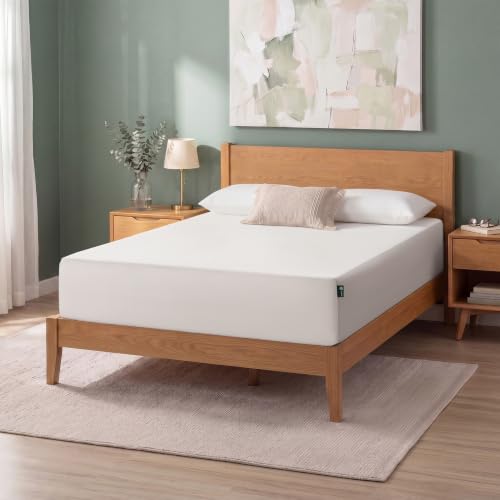
Zinus Memory Foam 12 Inch Green Tea Mattress
$239.9912 inch full memory foam.
Check price on AmazonFrequently asked questions
What are the dimensions of a full (double) mattress?
A full (double) mattress measures 54 inches wide by 75 inches long, or 137 by 191 centimetres. That works out to 28.1 square feet of sleeping surface. This is a standard US size, so it is the same from every manufacturer.
How big a room does a full (double) bed need?
For comfortable movement, allow the mattress plus about 3 inches of frame on each side plus 30 inches of walking clearance. For a full (double) that means roughly 120 inches of room width and 111 inches of length. You can get away with 24 inches of clearance, but a nightstand will crowd it.
What size sheets fit a full (double) mattress?
Buy sheets labelled full (double). The fitted sheet also has to clear the depth of the mattress, so check the pocket depth separately: standard pockets fit up to 12 inches, deep pockets 13 to 17 inches, and extra deep pockets 18 to 22 inches. A topper adds its full thickness to what the sheet must clear.
Is a full (double) long enough for a tall person?
A mattress should be about 4 to 6 inches longer than the tallest sleeper. At 75 inches, a full (double) suits someone up to roughly 71 inches tall, which is 5 feet 11 inches. Above that, look at an 80 inch length such as a queen, king or twin XL.
Does full (double) refer to thickness as well?
No. Size describes only the width and length. Thickness is separate and ranges from about 6 inches to over 16, with 9 to 12 inches counting as standard. Thickness changes the total height of the bed and the sheet pocket depth you need, but it never changes the 54 by 75 inch footprint.
How to read the numbers on this page. Standard mattress and bedding dimensions are industry-wide and the same across manufacturers. Guidance like replacement intervals, firmness by body weight and walking clearance is convention rather than a measured standard, and every table here says which it is. Where a manufacturer does not publish a figure we leave it out instead of estimating. This is not medical advice: a mattress is not a treatment for a medical condition, and persistent pain is a reason to see a clinician.