Size charts
Bed Frame Dimensions Chart
Quick answer
A bed frame deck should match the mattress size exactly. With a common 3 inch rail overhang per side, a Queen frame footprint runs about 66 by 86 inches. Published weight capacity ranges by frame type: basic metal 250 to 500 lb, heavy duty steel 700 to 1500 lb, wood 400 to 800 lb, upholstered 400 to 700 lb, adjustable base 450 to 850 lb. Walking clearance guidance: 24 in tight, 30 in comfortable, 36 in for a main walkway.
A frame is not just a deck cut to mattress size: its rails add a few inches of footprint on every side, its rated capacity depends entirely on its construction, and how much room you leave beside it decides whether the bedroom feels tight. These three factors are independent of each other and each one has its own published or conventional figures below.
On this page
Bed frame footprint by mattress size
| Mattress size | Mattress (in) | Frame footprint (in) |
|---|---|---|
| Twin | 38 x 75 | 44 x 81 |
| Twin XL | 38 x 80 | 44 x 86 |
| Full (Double) | 54 x 75 | 60 x 81 |
| Full XL | 54 x 80 | 60 x 86 |
| Queen | 60 x 80 | 66 x 86 |
| King (Eastern King) | 76 x 80 | 82 x 86 |
| California King | 72 x 84 | 78 x 90 |
Convention, not a standard
This is widely repeated guidance rather than a measured standard. Treat it as a starting point.
Frame footprint assumes 3 inches of frame on each side of the mattress, the overhang default used in Room Size and Clearance Calculator. Measure your own frame: some minimal metal platform frames add almost nothing, while upholstered frames with thick rails can add more.
Frame weight capacity by type
| Frame type | Min (lb) | Max (lb) |
|---|---|---|
| Basic metal platform frame | 250 | 500 |
| Heavy duty steel platform frame | 700 | 1500 |
| Wood platform frame | 400 | 800 |
| Upholstered frame | 400 | 700 |
| Adjustable base | 450 | 850 |
| Frame plus box spring | 400 | 900 |
Convention, not a standard
This is widely repeated guidance rather than a measured standard. Treat it as a starting point.
Capacity is sleepers plus the mattress combined, not sleeper weight alone: a King hybrid mattress alone can weigh well over 100 lb. The only number that governs a specific frame is the rating its own manufacturer publishes. Add your own numbers at Bed Frame Weight Capacity Calculator.
Walking clearance around the bed
| Clearance | Inches | What it feels like |
|---|---|---|
| Tight but usable | 24 | You can walk past sideways; a nightstand will crowd it |
| Comfortable | 30 | Normal walking clearance on the tightest side |
| Main walkway | 36 | Room to walk around the bed and open drawers freely |
Convention, not a standard
This is widely repeated guidance rather than a measured standard. Treat it as a starting point.
These are the widely repeated clearance thresholds, not a building code. Check your own layout with Room Size and Clearance Calculator.
Frame deck height vs total bed height
Frame dimensions and bed height are two different measurements that people often confuse. A frame's deck height is just the platform the mattress sits on. Total bed height, the number that decides how easy the bed is to sit on and rise from, is the frame deck height plus any foundation (box spring, bunkie board or adjustable base) plus the mattress thickness itself, added together. See the exact profile heights in the box spring height chart, and calculate your own total with Total Bed Height Calculator.
Shop frames built for capacity

FLEXISPOT S3K-Lite King Adjustable Bed Base
$359.99King base with head and foot incline.
Check price on Amazon
Mixcous King Adjustable Bed Frame with Zero Gravity Heavy Duty 750 lbs
$469.99King base with head and foot incline, a published capacity of 750 lb.
Check price on Amazon
Marsail Adjustable Bed Frame Queen Electric Base
$339.95Queen base with head and foot incline.
Check price on Amazon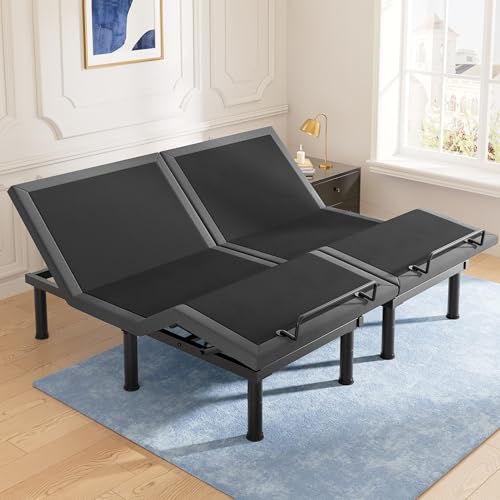
Tami Tami T450 Adjustable Bed Frame Split King with Remote
$499.99Split King base with head and foot incline.
Check price on AmazonFrequently asked questions
How much bigger should a bed frame be than the mattress?
A frame deck should match the mattress size exactly so the mattress is fully supported edge to edge. The frame's outer footprint, including its rails and any headboard or footboard, typically adds a few inches on each side beyond that, commonly around 3 inches per side for a simple platform frame. Upholstered frames with thicker rails can add more. Measure the specific frame's outer dimensions before checking it against your room.
What weight capacity does a Queen bed frame need?
It depends on the frame type and who is sleeping on it, not the mattress size. Add the combined weight of both sleepers to the mattress weight, then compare that total against the frame's published rating. A basic metal platform frame is commonly rated 250 to 500 lb, while a heavy duty steel frame can run 700 to 1500 lb. Two average adults plus a hybrid mattress can exceed a basic frame's low end easily.
Do metal bed frames need a box spring?
A metal platform frame with slats spaced closely enough to support a mattress does not need a box spring; the slats are the foundation. An older metal frame built only with side rails and no slats or a center support beam does need a box spring or a bunkie board underneath the mattress, or the mattress will sag and can void its warranty. Check the frame's own instructions before skipping a foundation.
How much walking space should I leave around a bed?
Widely repeated guidance puts 24 inches as the minimum to walk past a bed at all, 30 inches as comfortable normal clearance, and 36 inches as the space you want for a main walkway through the room, such as the path to a closet or door. These are not building code requirements, just conventional planning numbers. Run your own room dimensions against a specific mattress and frame footprint before buying.
Does an adjustable base work with a regular metal frame?
Not usually as a drop-in replacement. Most adjustable bases are designed to sit directly on the floor or inside a compatible frame with enough internal clearance for the base's motor and hinge points, and many require the base's own legs rather than a separate metal frame underneath. Check the specific base and frame's stated compatibility, or use a frame the base manufacturer explicitly lists as compatible.
What is the difference between frame capacity and mattress weight?
Frame capacity is the total load a manufacturer rates the frame to hold safely, which includes the mattress plus every sleeper on it. Mattress weight is just one part of that total, and it varies widely: a queen hybrid can weigh well over 100 lb on its own. Adding sleeper weight to mattress weight, then comparing that combined figure to the frame's published rating, is the only way to check the math correctly.
How to read the numbers on this page. Standard mattress and bedding dimensions are industry-wide and the same across manufacturers. Guidance like replacement intervals, firmness by body weight and walking clearance is convention rather than a measured standard, and every table here says which it is. Where a manufacturer does not publish a figure we leave it out instead of estimating. This is not medical advice: a mattress is not a treatment for a medical condition, and persistent pain is a reason to see a clinician.