Guides
Why Is My Mattress Sagging?
Quick answer
Sagging is usually a support problem before it is a mattress problem. Slats spaced too widely, a missing centre support leg, or an overloaded frame all produce a dip that looks exactly like mattress failure. Check the support underneath first, since a topper cannot fix a real sag and most warranties are voided by inadequate support.
A dip in the middle of the bed gets blamed on the mattress almost automatically, and sometimes that is correct. But the mattress is only one of three things holding it flat, the other two are the frame and whatever sits between the frame and the mattress, and either of those failing produces the exact same visual symptom: a dip you can see and feel. Sorting out which one actually failed changes whether the fix costs twenty dollars or a thousand.
On this page
What actually causes a mattress to sag?
A sag is simply a place where the surface no longer returns to flat after weight comes off it. That can happen inside the mattress itself, foam cells losing their spring or coils losing tension after years of the same two spots taking the same nightly weight. But it happens just as often below the mattress: slats spaced too far apart let the mattress flex downward between them night after night, a centre support leg that is missing or not touching the floor lets the middle of the frame flex under weight the outer rails were never meant to carry alone, and a frame loaded past what it can hold bends its own structure rather than staying rigid. All three produce a dip. Only one of them means the mattress is actually worn out.
How to check the support before blaming the mattress
- Pull the mattress off and look at the slats. Check spacing: gaps wider than about 3 inches let a mattress sag between them over time, especially foam and hybrid mattresses that have no independent structure of their own to bridge the gap.
- Confirm the centre support leg is actually touching the floor. Queen and larger frames commonly rely on a centre rail with a leg or two beneath it. If that leg is missing, unattached, or floating just above the floor, the middle of the frame is unsupported and will flex under weight even if every slat is intact.
- Add up the real load and compare it to the frame. Sleeper weight plus the mattress's own weight is the true load on the frame, and a king hybrid mattress alone can pass 100 lb. Run your numbers with Bed Frame Weight Capacity Calculator against what your frame type commonly publishes.
- Look at the shape of the dip. A dip that runs in a straight line, following a slat gap or the centre rail, points at the support. A dip shaped like a body, following where someone actually lies, points at the mattress.
- Only then inspect the mattress itself. With the support ruled in as sound, lay a straight edge or broom handle across the bare mattress. A gap of more than about an inch under the straight edge, with nothing on the bed, is the mattress losing its own structure.
How do warranties define a sag that counts?
| Measured how | Depth commonly covered |
|---|---|
| Straight edge across the bare mattress, nothing on the bed | Roughly 0.75 to 1.5 in, depending on the maker |
Convention, not a standard
This is widely repeated guidance rather than a measured standard. Treat it as a starting point.
This is a commonly published warranty threshold, not a universal number: check the specific mattress's own warranty terms. Nearly every warranty that covers sagging also excludes it outright when the mattress was used on inadequate support, meaning a missing foundation, unsupported slats, or a frame that does not meet the maker's stated requirements. Photograph the support before you file a claim.
Will a topper fix a sagging mattress?
When it really is the mattress
| Construction | Typical years |
|---|---|
| Innerspring | 5 to 7 |
| Memory foam | 8 to 10 |
| Hybrid | 7 to 10 |
| Latex | 10 to 15 |
| Pillow top | 5 to 7 |
Convention, not a standard
This is widely repeated guidance rather than a measured standard. Treat it as a starting point.
Age is a prompt to look, not a verdict on its own. A mattress well inside this range can still sag from poor support, and one past it can still be sound if the support underneath was always solid. Confirm with the straight edge test above, and check your own mattress against Mattress Replacement Timing Calculator.
Fix the support before you buy a mattress

Meliusly Heavy Duty Bunkie Board Queen Size - Under Bed Support
$119.99A flat, rigid support layer that removes wide slat gaps as a cause entirely.
Check price on Amazon
Yitong Angel 14 Inch Queen Bed Frame
$89.99Steel frame with a manufacturer-published capacity well above a typical two-sleeper load, including the mattress.
Check price on Amazon
SHA CERLIN 14 Inch King Size Metal Platform Bed Frame with Wooden Headboard an
$143.94A rebuild option if the current frame or its centre support has actually failed, not just the mattress.
Check price on Amazon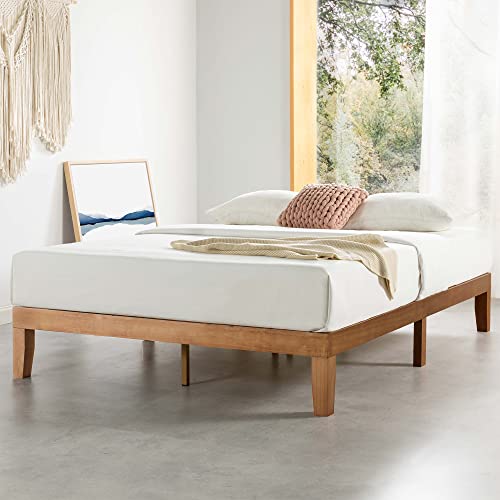
Mellow Naturalista Classic - 12 Inch Solid Wood Platform Bed with Wooden Slats
$185.99A solid wood platform frame as an alternative to steel, once the support itself is confirmed as the problem.
Check price on AmazonFrequently asked questions
Why is my mattress sagging in the middle?
Most commonly because the centre of the frame is not properly supported, either a missing or unattached centre leg, or slats spaced too widely at the middle where sleepers put the most repeated weight. Check the support first with a straight edge across the bare mattress: a dip that follows the slat pattern or the centre rail is a frame problem, not a worn out mattress.
Can a mattress sag from an overloaded frame?
Yes. A frame's published capacity has to cover the mattress plus the sleepers, not sleepers alone, and a king hybrid mattress can weigh over 100 lb on its own. A frame carrying a total load near or past its published range flexes under that weight, and the flex often shows up as a dip that looks like the mattress has failed even though the mattress itself is fine.
Does a topper fix a sagging mattress?
No. A topper is a thin surface layer with no structure of its own, so it sinks into whatever dip already exists rather than lifting it back to flat. If there is a visible body impression that stays after you get out of bed, the mattress or its support has lost structure, and the only real fix is addressing that, not adding a layer on top.
How much sag is covered by a mattress warranty?
Commonly somewhere between about three quarters of an inch and one and a half inches, measured with a straight edge across the bare mattress and nothing on it, though the exact figure varies by manufacturer. Check the specific warranty. Nearly all of them also exclude sagging caused by inadequate support underneath, so keep the frame and foundation in spec before filing a claim.
Does inadequate support really void a mattress warranty?
Very often, yes. Warranties are written around the assumption that the mattress sits on a support system the manufacturer considers adequate, meaning correctly spaced slats, an intact foundation, and a frame that meets any stated requirements. Sagging caused by wide slat gaps, a missing centre leg, or an overloaded frame is routinely excluded, even when the sag itself would otherwise qualify.
How do I know if it is the mattress or the frame?
Shape is the clearest signal. A dip that runs in a straight line, following a slat gap or the centre rail, points at the frame or foundation. A dip shaped like a body, in the areas where someone actually lies, points at the mattress itself. Checking the support first, before assuming the mattress has failed, saves buying a new mattress that would sag again on the same broken support.
How to read the numbers on this page. Standard mattress and bedding dimensions are industry-wide and the same across manufacturers. Guidance like replacement intervals, firmness by body weight and walking clearance is convention rather than a measured standard, and every table here says which it is. Where a manufacturer does not publish a figure we leave it out instead of estimating. This is not medical advice: a mattress is not a treatment for a medical condition, and persistent pain is a reason to see a clinician.