Comfort and bedding
Best Pillows by Sleeping Position
Quick answer
Side sleepers generally need the most loft, about 5 to 7 inches compressed under the head, while stomach sleepers need the least at 2 to 3 inches; the Coop Home Goods Original Adjustable Pillow at $89.00 is our top pick because its shredded foam fill can be added or removed to land in either range.
The Coop Home Goods Original Adjustable Pillow is our top pick among pillows in this roundup, priced at $89.00. It is filled with shredded memory foam behind a zippered cover, so loft is adjustable rather than fixed at one height. As a widely repeated convention rather than a measured standard, the loft a sleeper wants under the head changes with position: about 2 to 3 inches for stomach sleepers, 3 to 5 inches for back sleepers, 5 to 7 inches for side sleepers, and 4 to 6 inches for people who move between positions overnight. Loft here means the compressed height under the head once a sleeper is lying on the pillow, not the pillow's shelf height in the package.
On this page
Why does sleeping position change the pillow you need?
A pillow's job is to fill the gap between the mattress and the head so the neck stays level with the spine. That gap is a different size depending on position. A side sleeper has to fill the distance from the mattress up past the shoulder to the head, and a broader shoulder makes that gap bigger, which is why side sleepers generally need the most loft of any position and broader-shouldered sleepers need more than narrower-shouldered ones. A back sleeper's head sits closer to the mattress with less to fill, and a stomach sleeper needs the least loft of all, since too much height in that position tips the head at an angle. Use the Pillow Loft Calculator to check a loft range against your own shoulder width rather than guessing from position alone.
Which pillows are the best budget pick by position?
Beginner picks are fixed-loft pillows priced under $35. They do not adjust, so match the loft description on the listing to your position rather than assuming one pillow works for everyone in the house.

CushyOasis Memory Foam Pillows for Sleeping
$24.99A memory foam pillow at $24.99, a low-cost fixed-loft option for a spare room or a first pillow swap.
Best for: Back or combination sleepers on a tight budget
Check price on Amazon
Artelse Cervical Neck Pillow
$34.98A contoured pillow at $34.98, shaped with a raised edge that some back and side sleepers prefer around the neck area.
Best for: Sleepers who want a contoured shape rather than a flat rectangle
Check price on Amazon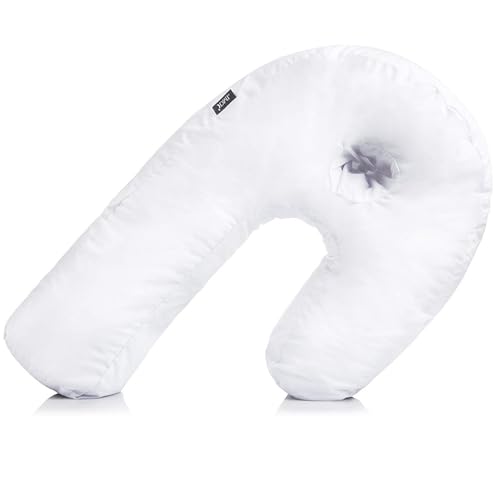
DMI U-Shaped Side Sleeping Pillows For Neck And Shoulder Pain
$25.79A U-shaped pillow at $25.79, built to fill the space around the head rather than sit only underneath it.
Best for: Side sleepers who want extra support along the sides of the head
Check price on AmazonWho should not buy this tier: Skip this tier if you are not sure which loft range fits your position yet. A fixed-loft pillow that turns out to be the wrong height cannot be adjusted the way the options in the tiers below can.
Which pillows are worth paying more for?
Intermediate picks add either adjustable loft in a lower-cost shredded foam fill or a shaped memory foam pillow aimed at a specific position. This is where most sleepers land once they know roughly which loft range they need.

Olive + Crate Adjustable Loft Shredded Memory Foam Pillow - Queen Size
$59.98An adjustable loft shredded memory foam pillow at $59.98, letting you remove fill to move from the side-sleeper range down toward back or stomach.
Best for: Combination sleepers who change position through the night
Check price on Amazon
Royal Therapy Memory Foam Pillow
$59.99A fixed memory foam pillow at $59.99, a mid-loft option sized for a standard queen pillowcase.
Best for: Back sleepers who want a consistent, non-adjustable loft
Check price on Amazon
Derila Ergo Cervical Neck Pillow for Sleeping Pillow Contour Memory Foam Pillo
$54.99A contoured memory foam pillow at $54.99, with a center dip shaped for back sleeping and raised sides for rolling onto your side.
Best for: Sleepers who switch between back and side through the night
Check price on AmazonWho should not buy this tier: Skip this tier if you already know a lower-priced fixed pillow or a higher-priced fully adjustable one suits you better, since these sit in the middle of both loft and price.
What is the top-of-the-line pillow option?
Expert picks are fully adjustable loft pillows, which cost more but let a sleeper dial in the exact height for their position and shoulder width rather than picking the closest fixed option.

Coop Home Goods Original Adjustable Pillow
$89.00An adjustable shredded memory foam pillow at $89.00, with a wide fill range that covers stomach through side sleeping in one pillow.
Best for: Households where different sleepers or positions share one pillow model
Check price on Amazon
DreamyBlue Signature Adjustable Shredded Memory Foam Pillow Queen
$75.00An adjustable shredded memory foam pillow at $75.00, a similar fill-and-adjust design to the top pick at a comparable price.
Best for: Shoppers who want a second adjustable option to compare
Check price on Amazon
NextSleep
$84.99A higher-priced pillow at $84.99, cataloged here as a back-sleeper option, for sleepers who have already tried a mid-range choice and want to move up.
Best for: Back sleepers upgrading from a fixed-loft pillow
Check price on AmazonWho should not buy this tier: This tier is not for anyone who has not measured their own shoulder width and preferred loft range first. Adjustable pillows cost more mainly for the ability to fine-tune loft, which is wasted if you have not identified the range you are tuning toward.
How do these pillows compare on specs?
| Spec | Coop Home Goods Original Adjustable Pillow | DreamyBlue Signature Adjustable Shredded Memory Foam Pillow Queen | Olive + Crate Adjustable Loft Shredded Memory Foam Pillow - Queen Size | Royal Therapy Memory Foam Pillow |
|---|---|---|---|---|
| Price | $89.00 | $75.00 | $59.98 | $59.99 |
| Size | Queen | Queen | Queen | Queen |
| Fill | Memory foam | Memory foam | Memory foam | Memory foam |
| Adjustable loft | Yes | Yes | Yes | - |
A dash means the manufacturer does not publish that figure for this product. We do not estimate it.
What loft range fits each sleeping position?
| Position | Compressed loft under the head |
|---|---|
| Stomach | 2 to 3 in |
| Back | 3 to 5 in |
| Combination | 4 to 6 in |
| Side | 5 to 7 in |
Convention, not a standard
This is widely repeated guidance rather than a measured standard. Treat it as a starting point.
How we chose
These picks are drawn from the products in our catalog and compared on the specs each listing publishes, mainly fill material and whether loft is adjustable. We have not tested these pillows in person, and loft-by-position guidance here is a widely repeated convention rather than a measured standard. Prices are pulled from the same listings and can change after publication.
Frequently asked questions
How much pillow loft do side sleepers need?
As a widely used convention, side sleepers generally need about 5 to 7 inches of compressed loft under the head, more than any other sleeping position. That is because a side sleeper's pillow has to fill the full distance from the mattress up past the shoulder to the head, and a broader shoulder makes that gap larger. A side sleeper with narrow shoulders may be comfortable near the bottom of that range, while a broader-shouldered sleeper often needs the top of it or an adjustable pillow.
Can one pillow work for every sleeping position?
An adjustable loft pillow, filled with shredded memory foam behind a zippered opening, comes closest, since fill can be added or removed to move the compressed height up or down. A fixed-loft pillow is built to one height and works best for whichever position matches that height. In a household with a stomach sleeper and a side sleeper sharing similar pillows, an adjustable model is the more practical single answer than trying to find one fixed loft that suits both.
What does compressed loft mean on a pillow listing?
Compressed loft is the height of the pillow once a sleeper's head is actually resting on it, not the fuller height the pillow has sitting empty on a shelf. A shredded foam pillow can look much taller in the package than it measures once weight is on it. Loft guidance by sleeping position, such as 5 to 7 inches for side sleepers, refers to this compressed height, so comparing it to an uncompressed shelf measurement will be misleading.
Should combination sleepers buy a different pillow than side or back sleepers?
Combination sleepers, who move between positions through the night, generally do best with a loft in the 4 to 6 inch range or with an adjustable pillow they can set toward whichever position they use most. A pillow built for side sleeping at 7 inches can feel too tall once a combination sleeper rolls onto their back, and a low stomach-sleeper pillow can feel too flat once they roll onto their side.
Is a contoured pillow different from a standard rectangular one?
A contoured pillow adds a shaped profile, often a center dip and raised edges, instead of a flat rectangular surface. Some back and side sleepers prefer the shape because it changes how the head and neck sit relative to the rest of the pillow. It does not change the loft-by-position guidance underneath: a contoured pillow still needs to land in a loft range that suits the sleeper's position, the shape is a preference on top of that, not a replacement for it.
How to read the numbers on this page. Standard mattress and bedding dimensions are industry-wide and the same across manufacturers. Guidance like replacement intervals, firmness by body weight and walking clearance is convention rather than a measured standard, and every table here says which it is. Where a manufacturer does not publish a figure we leave it out instead of estimating. This is not medical advice: a mattress is not a treatment for a medical condition, and persistent pain is a reason to see a clinician.